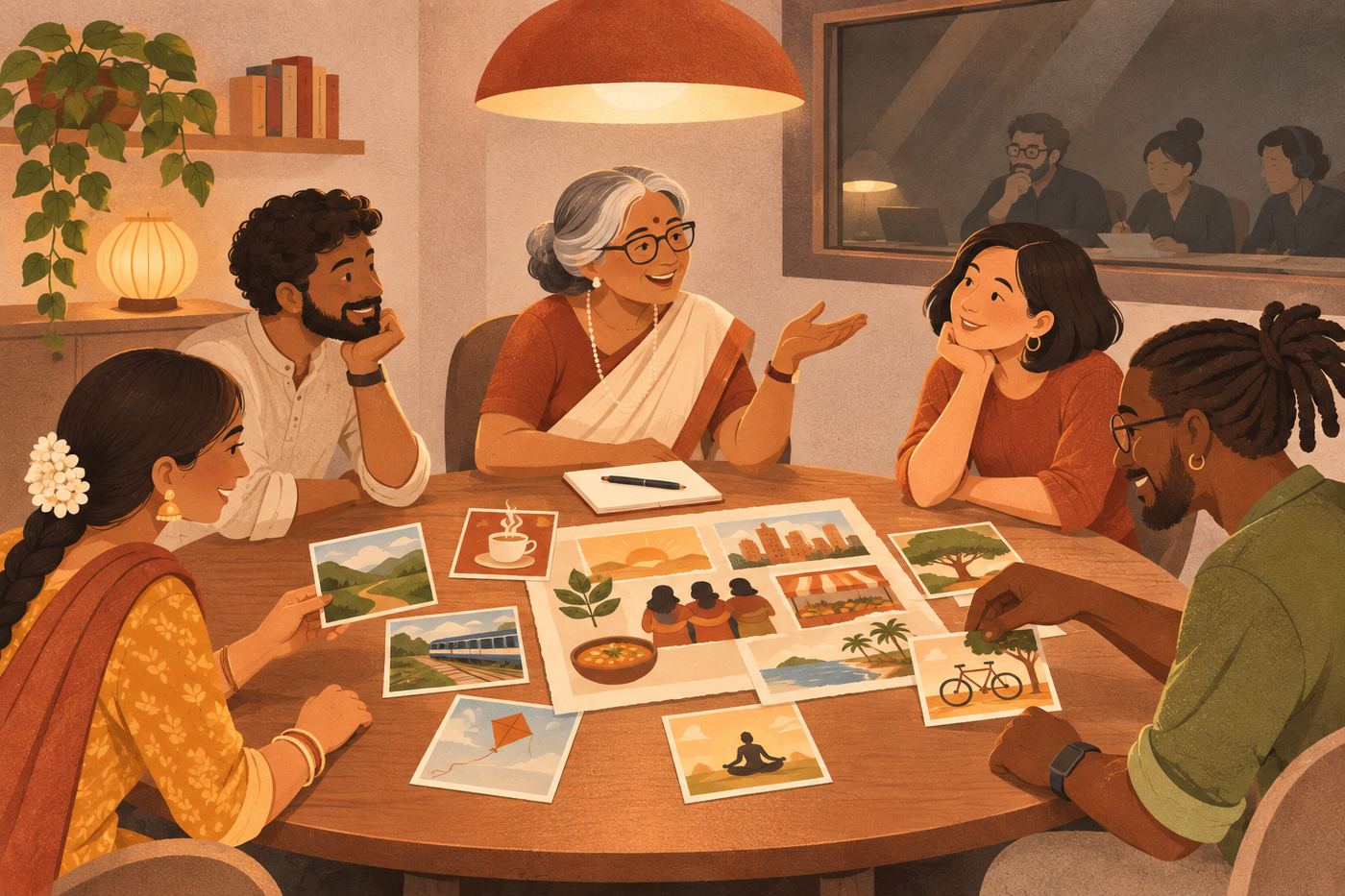
Design a study that could prove you wrong
- Write “what would change our mind” before fieldwork, and agree it with the stakeholders. It is your guard when they later pick the quotes that suit them.
- Say what qualitative can't do. Interviews describe, explain and generate. They don't size. If the decision needs “how many”, plan a survey too, and put that on the first slide of the plan.
- Sample for range, not representation. Recruit negative and extreme cases on purpose: lapsed users, rejecters, heavy users. Write “purposive sample: shows range, not prevalence”.
- B2B: twelve people from twelve firms beats twelve from three. Same-company answers echo each other.
- Mode changes the answers. Video interviews run more guarded in the first ten minutes; plan a longer warm-up and a show-me task.
- Several moderators? All of them run the same two pilots and compare notes before fieldwork.
When to stop, said honestly
“Saturation” covers two different things. Code saturation, no new topics, comes early: by about twelve interviews in a similar group (Guest et al., 2006). Meaning saturation, understanding the issue in depth, takes longer, and themes that hold across several sites took 20–40 interviews in one cross-cultural study (Hagaman & Wutich, 2017). Braun and Clarke (2019) go further: for reflexive thematic analysis, saturation is the wrong idea, and when to stop is a situated judgement.
So report the reason, not the word. “We stopped because the last three interviews in each of the four segments gave no new reasons for switching, and one deliberately different respondent per segment confirmed it.” For India, remember that language, region, income and city tier shrink what counts as a “similar group”.
Observers and stakeholders
- The moderator owns the guide. Observers write questions on a card or in a back-channel chat, one per break, and the moderator decides whether to ask them.
- A vendor or boss watching chills criticism, especially in small B2B markets. Prefer audio-only observation or review of recordings.
- Respondents are told who is watching and in what role, and may withdraw if they could know the observer (MRS Code, rules 39–41).
- Pre-empt “only two said it”: show how the sample was built and report patterns as most, some or a few.
Consent and data, designed in
Tell people, at recruitment and again at the start: who is collecting, why, what is recorded, who will hear or see it, how long it takes, that they can skip or stop, what happens to the recording, and how long it is kept (MRS Code 2023, rules 29–31). Get the yes on the recording.
- AI tools: say the recording will be turned into text by an automated service, where it's processed if you know, whether a person reads it, and whether anyone's models train on it. If you can't answer, find out before you promise.
- India: the Digital Personal Data Protection Act, 2023 and its 2025 Rules bring in notice, consent, withdrawal, security and retention duties in phases, and treat anyone under 18 as a child who needs verifiable parental consent. Work to notice-and-consent now, and have counsel check the current text before you rely on any exemption.
- EU or UK respondents: GDPR applies. You need a legal basis and the same information list.
- Small worlds: a pseudonym doesn't hide “the only distributor in Raipur”. Strip role and company, or get explicit permission.
- Retention by purpose: raw audio only as long as you need to verify quotes; de-identified transcripts longer if needed; delete on request.
- Files: one access-controlled store, never WhatsApp or a personal drive. Name files by ID (R07), keep the key file apart.
Specialist techniques, and when they mislead
Enabling techniques help people say what is hard to put into words: drawing, sorting, collage. Projective techniques give a third-party frame, so people can say what they'd hold back about themselves (Will, Eadie & MacAskill, 1996). Both generate hypotheses. A drawing is a prompt for talk; the talk is the data.
They mislead when the person is tired, rushed or suspicious and reads it as a test; when you read the drawing instead of asking about it; in groups, where the first answer gets copied; and when drawing or writing embarrasses someone. Always say there's no right answer, let them finish, then ask “Tell me about that.”
| You need | Technique |
|---|---|
| Feelings that are hard to say | Sentence completion, personification, obituary |
| A sensitive topic | Third-person questions, thought bubbles |
| Lifestyle and aspiration | Collage as a pre-task |
| How people carve up a category | Picture or card sort |
| Why an attribute matters | Laddering |
| Why they switched | Four forces |
| What they really do | Contextual inquiry, artefacts |
| Whether a survey question works | Cognitive interviewing |
| Behaviour over days or weeks | Diary pre-task, repeat interviews |
Sentence completion
“I'll say the start of a sentence. Finish it with the first thing that comes to mind.”
“People who use this oil are…” / “When I run out of this, I feel…”. Compare the “people who” version with the “I” version; the gap is the interesting part.
Example: “People who use this oil are… old-fashioned.” Probe: “My mother-in-law uses it. I use serum, but I still oil on Sunday.” Ritual intact, image at risk. Not “oil is dying”.
Brand as a person
“Imagine this brand is a person you could meet. How old, what do they do, how do they speak? They walk into a party: who do they talk to?”
Repeat for each competitor and compare. Look for what the brand would never do. Only use brands the person actually knows; otherwise you get clichés.
Thought bubbles
A simple drawing of a shopper at a shelf, with a speech bubble and a thought bubble. “What is she saying? What is she thinking but not saying?”
“Say: ‘Give me the usual.’ Think: ‘This one is ₹12 cheaper, but what if the kids don't like it.’” Risk, not price, holds the habit. Follow with “Is that you?”
Obituary
“This brand is gone tomorrow, forever. A short notice is in the paper. What does it say? Who is sad?” A dull notice means an easy-to-replace brand.
B2B: “Finance would be a bit annoyed. We'd use Excel.” Low switching cost; retention risk.
Collage pre-task
“Send me six to ten photos that show how you want your hair to look and feel, and three that show what you don't want.” In the interview: “Which matters most? Which did you almost leave out?”
Photos from her own gallery are behaviour; saved images are aspiration. Know which you're reading.
Card sort and trade-off
“Put these into groups and name each group.” Then: “Keep only three. Now give one up. Which, and why?”
D2C skincare: most kept “30-day return” over every ingredient claim. “I've been burnt by serums before.” Report the reasons, never a percentage of eight.
Laddering, properly
Laddering moves from an attribute to its consequences to a personal value (Reynolds & Gutman, 1988). Start from attributes she chose herself, then ask the same question again and again, in varied words: “What does that give you?” “What would be missing without it?” Stop at a value, at “it just is”, or at fatigue. If she goes flat, drop back to “Tell me about the last time.”
“It's non-sticky.”
“I can go to office without washing it out.”
“I don't feel embarrassed in front of colleagues.”
“I want to be seen as put-together.”
The benefit isn't “light formula”; it's “presentable on a Monday”. Ladders drift toward socially approved values like family and health, so cross-check the top rung against what she does.
The four forces of a switch
Two forces push toward change, two hold people back (Moesta & Spiek). Change happens when push plus pull beats anxiety plus habit. Most teams study pull and ignore the other three.
| Force | Ask | D2C skincare example |
|---|---|---|
| Push | “What was wrong with what you had?” | An acne flare before a wedding |
| Pull | “What drew you to the new one?” | A friend's before-and-after on WhatsApp |
| Anxiety | “What nearly stopped you?” | “What if it breaks me out more?” |
| Habit | “What made it easy to stay as you were?” | “Same face wash for six years.” |
Here a sample sachet and a return promise did more than a new claim, because they worked on anxiety.
Contextual inquiry and artefacts
Beyer and Holtzblatt's model: go to where the work happens; the person is the master and you are the apprentice; say your reading back to check it (“So you fry with this one and keep that one for guests. Did I get that right?”); keep to the task you came for. Describe before you interpret: “three oil bottles, one half full, behind the rice” first, “premium oil kept out of reach for special use” second, and only after she has explained it.
A cupboard of five open shampoo sachets and no bottle: “I buy what I can pay for that week.” Pack size follows cash flow, not brand preference.
Cognitive interviewing, for survey questions
After someone answers a draft survey item, probe how they got there: “In your own words, what is this asking?” “What does ‘regularly’ mean to you here?” “How did you work out your answer?” “How sure are you?”
“How often do you use hair oil?” One person counts the Sunday scalp massage; another counts every day it's in her hair. The item needs rewording, and the Hindi “lagana” versus “istemal karna” needs its own test.
Diaries and repeat visits
A short WhatsApp diary (a photo and a voice note each time she uses the product, for a few days) gives you real events to interview about: “On Tuesday you sent this. Tell me about that evening.” Missing days may be the interesting ones. Repeat interviews weeks apart let you compare prediction with behaviour: “I'll use it every night” becomes “five nights, then I travelled”. Note that repeat respondents become more research-aware.
Sensitive topics, children, languages, power
Health, money, hygiene, caste
- Same-gender interviewer for intimate topics; a private place, or a different format.
- “Some questions are personal. You can say ‘pass’ at any time.”
- Use her words for the body. Practise saying them aloud beforehand.
- Money in ranges, not figures. Caste or religion only if the study needs it, at the end, optional.
- Distress: pause, acknowledge, offer water, offer to stop. Don't probe trauma or ask “why” about it. Carry a list of local support services.
Under 18 in India
- Parent or guardian consent first, then the child's own agreement in simple words.
- A responsible adult within sight and hearing. Never alone with a child.
- Short sessions, play and props. Let the child be the expert: “Teach me how you play it.”
- Name a safeguarding contact before fieldwork. If a child discloses harm: stay calm, don't promise secrecy, follow the process.
Translate and back-translate
- Write the guide in plain English.
- A bilingual person who knows the topic translates for meaning.
- A second person translates it back without seeing the original.
- Compare; fix where meaning drifted.
- Pilot with one or two native speakers.
- Keep a glossary of agreed terms across interviewers.
Report who translated and how. Many published studies don't (Squires, 2009).
Working through one
- Brief: “Translate everything. Don't summarise, don't add.”
- Look at the respondent, not the interpreter; speak in the first person.
- Watch caste, class and gender between interpreter and respondent. Avoid relatives and close neighbours.
- Debrief: “What did you notice? What was hard to translate?” Record the original audio.
Reading power in the room
Who speaks first, who corrects whom, and who looks at whom before answering are all data. When a daughter-in-law says “we always buy X” in front of her mother-in-law, ask later, alone or by phone: “When you shop on your own, is it the same?” If a third of your recordings were led by the head of the household, say so in the analysis. In dyads and family interviews, the negotiation is the unit of analysis, and every quote needs the right speaker label.
Analysis someone else can audit
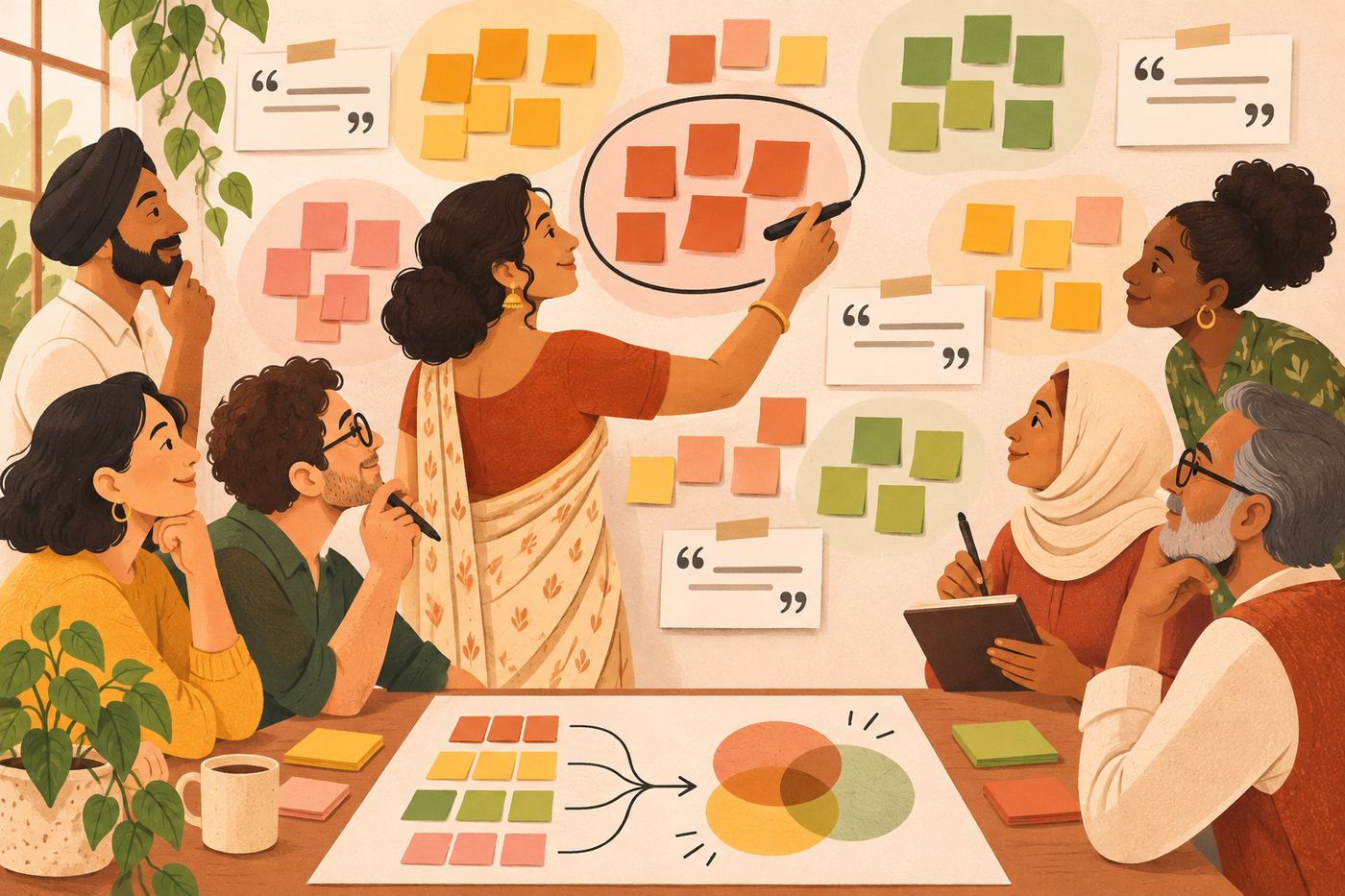
Reflexive thematic analysis
Braun and Clarke's six phases, which loop back on each other:
- Familiarise: read, re-read, listen to the audio, make notes.
- Code: mark interesting features across the whole dataset.
- Generate initial themes: cluster codes around a shared idea.
- Review: test themes against the extracts and the whole dataset.
- Define and name: say what each theme is, and what it isn't.
- Write up.
Themes don't “emerge”: you build them, and your background shapes them. Write your assumptions down before you start. A theme is a pattern of shared meaning, not a topic heading:
Finding or insight?
Six of eight women washed the pack before opening it.
Sealed packs aren't trusted because past adulteration stories taught them “sealed” is a claim, not proof. A visible tamper cue may do more than a quality claim.
If the client says “we knew that”, it's a finding. An insight is non-obvious, supported and usable.
Make it checkable
- Audit trail: for each claim, the supporting quote IDs, the counter-quote IDs, and how the claim changed.
- Count from coded data, not memory. Memory over-counts the vivid. Anyone who says “7 of 10” should be able to list the seven by ID and quote.
- Code from the original language where the team reads it, and translate only for the report. Translation flattens register: “aap” versus “tum”, dialect, sarcasm.
- Reflexivity statement: who interviewed, in what language, what you assumed, and how your position (brand-side, outsider, a male visitor in a women's household) may have shaped what was said.
- Argue the opposite. After the first synthesis, write the strongest case that your main theme is wrong, using only the transcripts.
Use AI as a second reader, then check it
Transcription, translation drafts, search across transcripts and first-pass summaries save hours. They also fail in ways that read just as fluently as success. Studies of LLM-assisted thematic analysis report unstable codes and unreliable quote selection.
| Failure | Looks like |
|---|---|
| Altered quotes | Tidied wording presented as her words; sometimes a sentence nobody said. |
| Wrong speaker | The husband's line in the wife's column, especially with overlap or Hindi–English switching. |
| Flattening | The average survives; the contradiction, the minority and the hesitation disappear. |
| Lost context | A “yes” quoted without the leading question that produced it. |
| Invented counts | “Most respondents” that turns out to be three. |
Nine checks before anything AI-made goes in a report
- Find every quote as an exact string in the transcript. Not found, not used.
- Listen to ten seconds at the timestamp to confirm the speaker.
- Read three turns either side. Was it an answer to a leading question?
- Recount any count and list the people by ID.
- Ask for the opposite: “Which respondents disagree? Quote them.” Then verify those too.
- Read two transcripts end to end. If the summary misses the moment you remember best, it's flattening.
- Code a few interviews yourself first. The tool is the second reader, not the first.
- Check where the audio goes, how long it's kept, whether it trains models, and that the consent covered it.
- Log it: tool, version, prompt, date, and what you verified.
AI summary:“Most mothers feel guilty about sugar in biscuits.”
After checking:Three of eight said so. Two said “my child needs energy”. The quote used for guilt was the grandmother's.
Rewritten: “Guilt about sugar came up in three of eight homes, mainly among younger mothers; grandmothers were relaxed about it.”
Suggested live probes from an AI tool are prompts from a junior colleague: often leading, sometimes off-culture. Never read one out unchecked, and never let a bot interview people about a sensitive subject without a person in the loop.
Review yourself, then teach someone
Listen back to all of your first five interviews on any new topic, and one in three after that. Take ten minutes from the middle and score each line 0, 1 or 2.
| Check | What good sounds like |
|---|---|
| Talk ratio | You speak well under a quarter of the time. |
| Leading | No questions that contain the answer, offer your options, or use your words. |
| Closed | Yes/no only when you meant it. |
| Stacked | One question per breath. |
| Silence | Pauses left open; not every gap filled. |
| Follow-up | Interesting phrases chased (“You said ‘embarrassed’…”) more often than the guide moved on. |
| Reactions | No “great”, “exactly”, “I agree”. |
| Her words | Probes use her vocabulary, not your category jargon. |
| Surprise | Something surprised you, and you probed it. Nothing surprising may mean you were steering. |
Mistakes that come with experience
- Not hearing disconfirming evidence because “I've seen this before”.
- Seeing depth that isn't in the data.
- Presenting a theory as a finding because the client wants a story.
- Letting an AI summary stand in for re-reading the transcript.
- Keeping the craft private, so juniors are never observed.
Coaching drill
Take a junior's recording. Mark five moments with timestamps: one strength, and the leading or closed questions. Rewrite them together, set one target for the next interview, and listen to that one too. Teaching exposes your own gaps faster than anything else.
Check yourself
A client wants “saturation reached” in the report after ten interviews across four states. What do you write?
The stopping reason per segment, and where segments are thin. Twelve can be enough for one similar group; themes across sites took 20–40 in Hagaman and Wutich's study.
Why do Braun and Clarke say themes don't “emerge”?
Because the analyst builds them through interpretation, shaped by position and questions. So the analysis states its assumptions.
A stakeholder wants five punchy clips for a reel. How do you stay honest?
Typical, not extreme; spread across people; one dissenting clip; no cuts that change meaning; captions with ID; consent for sharing checked.
What goes in a reflexivity statement?
Who interviewed, your assumptions before fieldwork, how your position may have shaped answers, and what you did about it.
Send the Beginner path to your team
Juniors and observers get the most from the first path. Share it before their first home visit or customer call.
Sources
- Braun, V. & Clarke, V. (2006). Using thematic analysis in psychology; (2019) To saturate or not to saturate?; (2022) Thematic Analysis: A Practical Guide. Sage.
- Guest, Bunce & Johnson (2006), Field Methods 18(1); Hagaman & Wutich (2017), Field Methods 29(1).
- Reynolds, T. J. & Gutman, J. (1988). Laddering theory, method, analysis, and interpretation. Journal of Advertising Research 28(1), 11–31.
- Will, V., Eadie, D. & MacAskill, S. (1996). Projective and enabling techniques explored. Marketing Intelligence & Planning.
- Holtzblatt, K. & Beyer, H. (2016). Contextual Design; NN/g on contextual inquiry.
- The four forces of progress (Moesta & Spiek).
- Willis, G. (2005). Cognitive Interviewing. Sage.
- Squires, A. (2009). Cross-language qualitative research. Int. J. Nursing Studies 46(2).
- MRS Code of Conduct 2023; India's Digital Personal Data Protection Act, 2023 and DPDP Rules, 2025 (check the official text).
- LLM-assisted thematic analysis: opportunities, limitations and recommendations (arXiv, 2025).