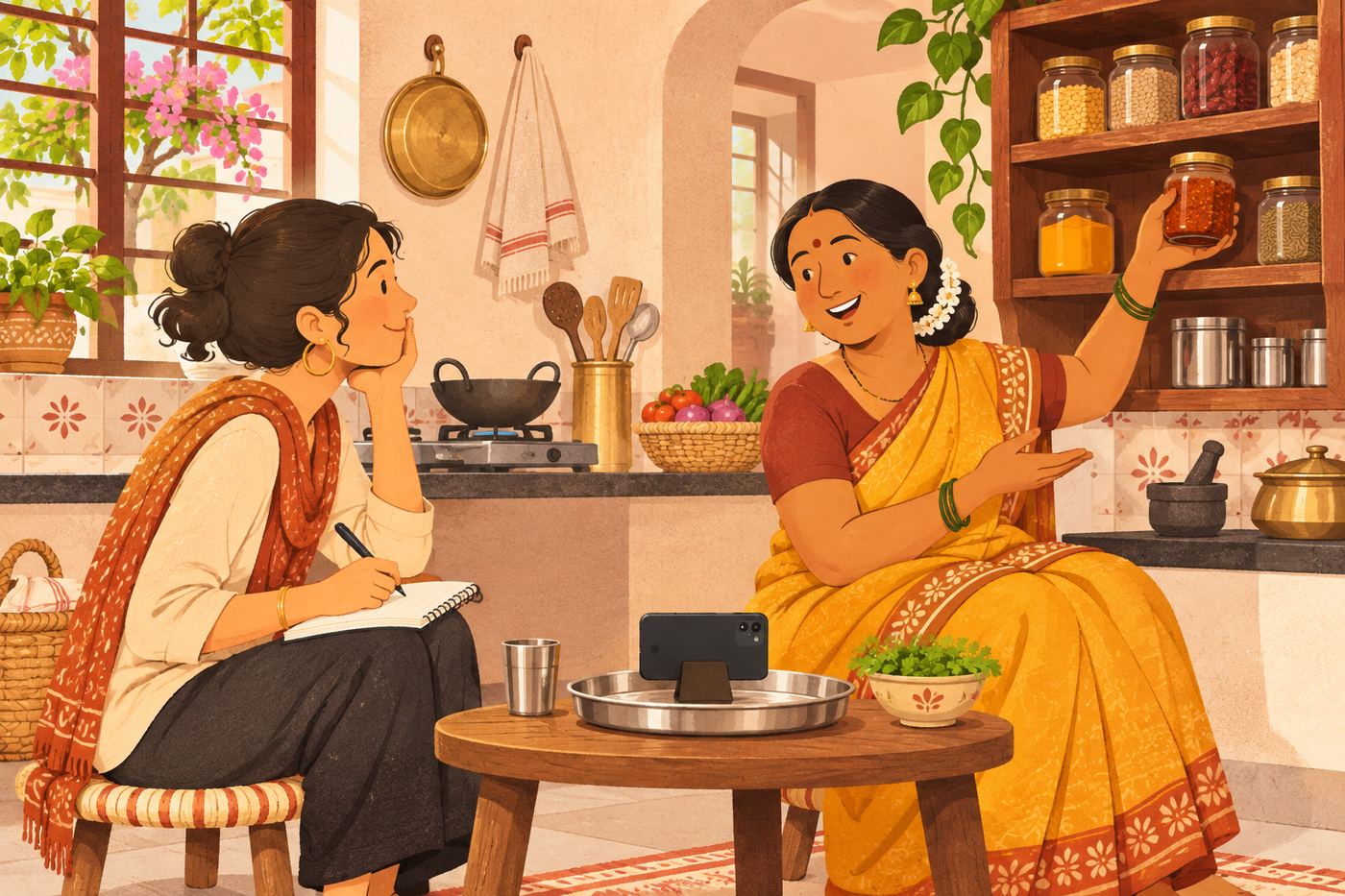
Plan in twenty minutes
Most weak interviews come from a vague goal, not a weak interviewer. Twenty minutes at a desk fixes that.

Write the decision, then three to five guesses
Finish one sentence: “After these interviews, we will decide whether to ___.” If you can't finish it, you are exploring. That is allowed, but say so to whoever asked for the work.
Decide whether to launch a ₹5 sachet of our hair oil in UP. Guess: “I buy the small one when money is short that week.”
Decide whether to fix checkout or the product page first. Guess: “I almost left when I saw the delivery charge.”
Keep the guesses to yourself. They tell you what to ask about. You never read them to the person, and you never steer toward them.
Who, and how many
- People who did the thing recently. “Bought hair oil in the last four weeks” beats “uses hair oil”. Recent behaviour is remembered; general habits are guessed.
- Include a few who disagree. Someone who stopped buying, or never started, will tell you more than a fan.
- Start with five or six per kind of person. Fewer than three is a story, not a pattern. Add more only while you are still hearing new things.
- No family, friends or colleagues. They are kind to you, which is the opposite of useful.
A 30-minute guide
A guide is a map, not a script. You may skip, reorder and follow a good story. Star the questions you must ask; everything else can be dropped.
| Minutes | Section | What happens |
|---|---|---|
| 0–3 | Welcome and consent | Who you are, why you're here, recording, right to stop. |
| 3–7 | Their day | Who lives here, who buys, what their work is. Easy questions with no wrong answers. |
| 7–20 | The last time ★ | “Walk me through the last time you…” Stay inside that one story. |
| 20–26 | Show me | The cupboard, the pack, the app, the receipt. Watch, then ask. |
| 26–30 | Close ★ | The door question, thanks, what happens next. |
Aim for six to ten main questions, not forty. Depth beats coverage.
Pack the bag
- Phone charged, storage free, on Do Not Disturb. Test a 10-second recording and play it back.
- A second recorder (another phone) for any visit that matters.
- The guide on one printed page, and a notebook with two pens.
- The thing itself: your pack, the old pack, a competitor's. People talk about objects far better than ideas.
- The thank-you, and the respondent's name, address and number.
- Remote: link sent the day before, a reminder one hour before, and their phone number in case the video drops.
The first five minutes
Your goal: she feels safe, knows what will happen, and starts talking in long sentences.

Consent, before and on the recording
Ask before you press record, then ask again once it is recording, so the yes is on the tape.
“Before we start, may I record our talk? Then I don't have to write while you speak. Only our team will listen to it, and a computer will help turn it into text. You can skip any question or ask me to stop at any time, and if you want, I'll delete it. Is that okay?”
“शुरू करने से पहले, क्या मैं हमारी बातचीत रिकॉर्ड कर सकती हूँ? ताकि आप बोलें तो मुझे लिखते न रहना पड़े। इसे सिर्फ़ हमारी टीम सुनेगी। आप कभी भी रुकने को कह सकती हैं, और आप कहें तो मैं इसे मिटा दूँगी। ठीक है?”
Say only what is true. If the recording goes to an agency or an AI transcription tool, say so. The Hindi is written for a woman speaking to a woman; a man says “कर सकता हूँ” and “मिटा दूँगा”.
Then say this, in this order
“I'm not selling anything, and I didn't make anything you'll see today, so you can't hurt my feelings. There are no right or wrong answers. I want to learn how you really do things.”
“Main aapko kuch bechne nahi aayi hoon. Mujhe bas samajhna hai ki aap ghar mein yeh kaise karti hain. Koi sahi ya galat jawab nahi hai.”
- First question: easy, factual, about them. “Tell me a bit about your household. Who lives here?” or, on a work call, “What does your team do day to day?”
- Make the first answer a story. If you accept a one-word answer now, you have taught her that one word is what you want.
- In a home: accept the tea, take your shoes off if the family does, sit at her eye level, and wait to be shown where to sit.
Ask about the last time
People are poor at predicting what they would do and good at telling you what they did. So ask about one real event in the past, not what they “usually” do or “would” do.
“Tell me about the last time you bought it. When was that? Where were you? Who was with you? What happened first?”
If she says “usually…”, pull her back gently: “That helps. Can we take the last time it actually happened?”
Five kinds of question that spoil the answer
| Type | Sounds like | Fix |
|---|---|---|
| Leading | “Don't you think the old pack was better?” | Remove your opinion from the question. |
| Loaded | “Is it important that your atta is healthy?” | Drop the judgement word (healthy, cheap, easy). |
| Double | “Was it nice and easy to open?” | One idea per question. Hunt for “and” and “or”. |
| Future | “Would you buy this at ₹50?” | Ask what she did last time. |
| Closed | “Do you check the label?” | Start with “Tell me about…” or “Walk me through…”. |
Twelve swaps to copy
How a lead sounds on the recording
You:Do you find the new pouch easier to pour?
Her:Yes, it's fine.
You supplied “easier”. “Fine” is a polite answer. Nothing was learned.
You:Show me how you opened it the last time.
(She tears the corner. Some spills.)
Her:Oh, it always spills a little. I use scissors now.
You:Scissors?
Her:The corner doesn't tear properly, so I keep a pair near the stove.
Behaviour first. A detail appeared that no yes-or-no question would have found.
Probe, then be quiet
The first answer is the short version. The probe gets the real one. Use the lightest probe that works: silence first, then her own words back, then a question.

Six probes that need no preparation
| When | Say | Hinglish |
|---|---|---|
| The answer is short | Silence. Count to five in your head. Nod. | no words |
| She says something striking | Repeat her last words: “…spills a little?” | “…thoda spill hota hai?” |
| She stops early | “Tell me more about that.” | “Thoda aur bataiye.” |
| A vague word (“good”, “fine”) | “When you say fresh, what do you mean?” | “Accha matlab?” |
| She describes a process | “Can you show me?” | “Mujhe dikhaiye, aap kaise karti hain?” |
| You lost the thread | “What happened next?” | “Phir kya hua?” |
Keep your reactions flat
“Great!”, “Interesting!” and “Exactly!” tell her which answers you want more of, and you will get more of them. Use plain acknowledgements: “Mm-hmm.” “I see.” “Go on.” “Thanks, that helps.” In Hindi: “Hmm.” “Achha.” “Bataiye.”
- Don't finish her sentences, correct her, or share your own experience.
- Keep the same face for a shocking answer as for a dull one.
- She should talk at least three-quarters of the time. If you're explaining, you're not listening.
When it goes sideways
| What happens | What to do |
|---|---|
| One-word answers | The question was too abstract. Ask for something physical: “Show me the shelf.” Then a story: “Start with where you were.” |
| She rambles | Let it run a little; she may be telling you what matters. Then bridge with her words: “You said the shop was crowded. Tell me about that.” |
| She praises everything | “Tell me about a time it didn't work. Others have had problems too.” |
| The husband or mother-in-law answers | Thank them, then ask her by name: “That helps, Aunty. I'd love to hear from Priya too, since she cooks. Priya, what did you do?” Note who said what. |
| She gets upset | Pause. “We can take a break, or skip this. What would you like?” Don't push and don't rescue. |
Close at the door, not before
Give a five-minute warning, then ask the door question with your notebook closed:
“Is there anything I should have asked you, and didn't?”
Many of the best sentences come as you stand up and put your shoes on, once she no longer feels interviewed. Keep recording until you are outside, which her consent should cover. Then thank her, hand over the thank-you, and say what happens next.
Write it down before the next visit
The best quote is gone by evening. In the car, the auto or the next room, write five short lines.

- Three quotes in her exact words, in the language she said them. “Pouch pe bharosa nahi hota” is evidence. “She distrusts pouches” is your summary of it.
- The minute she said each one, from the recorder, so anyone can find it.
- One surprise: what you did not expect.
- Who was in the room, and anything that interrupted.
- One question for the next person.
Counting honestly
- “3 of 5 people said it” describes your five people. It is not “60% of customers”. Never turn a small count into a percentage.
- Every claim you write up needs at least one quote in her words, with who said it and when. No quote, no claim.
- If you asked “so it's too expensive?” and she said “yes”, that is your idea, not hers. Mark it as prompted.
Four drills for your next three interviews
Use your own recordings. Ten minutes of listening back teaches more than another article.
Count your leads
Listen to one interview. Mark every question you asked: open, closed, leading, or two-in-one. Aim for fewer than one leading question in ten next time.
Time yourself
Over ten minutes of audio, time how long you speak. Above a quarter of the time, you are explaining, not listening.
Rewrite five questions
Take five questions from your guide and turn each into a “Tell me about the last time…” question.
Hold the silence
After every answer, count to three before you speak. Tally how often she added something.
Check yourself
Which question best shows how someone chooses a shampoo?
a) “Do you prefer a brand you trust?” b) “Tell me about the last time you bought shampoo.” c) “Is price important?” d) “Why do you like Brand X?”
b. It is open, about a real past event, and hints at no answer.
She gives a one-line answer. What's your first move?
Wait three seconds, then “Tell me more about that.” Not “Great!”, and not the next question.
True or false: “6 of 10 said it” means 60% of customers think it.
False. It describes your ten people only.
What must sit next to every claim in your write-up?
A quote in the person's own words, with who said it and at what minute.
Ready for Intermediate when, on your last three recordings:
- You talk less than a quarter of the time.
- Fewer than one question in ten is leading or closed.
- You can sit through three seconds of silence.
- You've run ten interviews and listened back to five in full.
- Every claim in your notes has a quote with a minute mark.
Intermediate: interviews that hold up
Screeners, settings, deeper probing, and turning notes into findings a team will trust.
Sources
- Flanagan, J. C. (1954). The Critical Incident Technique. Psychological Bulletin 51(4), 327–358.
- Fitzpatrick, R. (2013). The Mom Test. Past specifics over future promises.
- Portigal, S. (2023). Interviewing Users, 2nd ed. Rosenfeld Media.
- Nielsen Norman Group: Leading questions; How many interviews are enough?
- dscout People Nerds: Qualitative interview mistakes.
- Talk-time and silence targets are practitioner rules of thumb, not tested standards.